
What Lives Under Your Hull: A Guide to the Mediterranean Sea
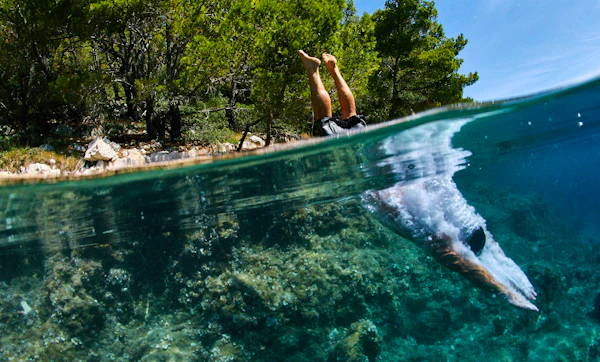
Welcome on board! As you step onto your vessel and look out at the crystal-clear water, it’s easy to focus entirely on the horizon. But just a few meters below you lies one of the most vibrant, ancient, and fragile ecosystems on Earth. The Mediterranean accounts for less than 1% of the world’s ocean surface, and yet it is home to over 17,000 marine species, many of which cannot be found anywhere else on the planet.
You aren’t just a traveller on a holiday; you are a temporary resident in a massive and frail underwater home. To help you connect with your new surroundings, here is an in-depth guide to our underwater neighbours, the secrets that keep these waters blue, and how you can ensure your journey leaves only good memories, not a trace of damage.

The Fascinating World Under Your Boat
The moment you put on your mask and snorkel and lower yourself from the swim platform, you enter a lively community. The Mediterranean coastline is full of rocky reefs and sandy bays, each a host to a unique cast of characters.
When you drop anchor and look over the side of the deck, you aren't just looking at the empty blue sea. The Adriatic is packed with life. Here are the usual "suspects" you’re most likely to spot right under your hull:
Sardines (Sardina pilchardus / Srdela): You’ll usually see these guys in big silver schools just below the surface. They are one of the most important pieces of the Mediterranean food chain. If you see a school of sardines swimming around, bigger fish probably aren't far behind trying to eat them!
Gilt-head Bream (Sparus aurata / Komarča): Look for a bright silver flash near sandy bottoms or seagrass meadows. You can recognise them by the distinct golden stripe between their eyes. If you’re snorkelling and hear a faint crunching sound, it’s likely a gilt-head bream using its powerful jaw to snack on crabs and shells.
The Common Octopus (Octopus vulgaris / Hobotnica): They are master shapeshifters, instantly changing their colour and skin texture to blend into the surrounding area. A great trick for spotting them is looking for a pile of broken shells on the seabed. Octopuses leave their leftovers right outside their den, which looks like a messy doormat.

Sea Urchins (Echinoida / Ježinci): You'll spot these little creatures clinging to the rocky shallows. While sea urchins mean you need to watch your step when walking ashore, they are actually great news! They only thrive in clean, unpolluted water, so seeing them means you're in a perfectly clean bay.
The Seahorse (Hippocampus / Morski konjic): Hidden deep within the Posidonia seagrass meadows lives the Adriatic’s most patient resident. Seahorses are notoriously terrible swimmers, so they wrap their tails around the seagrass to keep from getting swept away by the current. Spotting one takes serious patience, but it’s worth the hunt.
The Rare Gems in Our Sea
Finding sardines and urchins is easy, but if you spot any of these next few characters during your charter week, you’ve hit the lottery. These are the rare, protected locals that even the skippers get excited about.
Bottlenose Dolphins (Tursiops truncatus / Dupini) There is nothing like seeing a dolphin right next to your boat. The Adriatic is home to a population of Bottlenose Dolphins, very social and intelligent. If they choose to swim alongside you, enjoy them, and never try to jump in with them.
Loggerhead Sea Turtles (Caretta caretta / Glavata želva) You can see them at the surface while they’re warming up their shells. The Northern Adriatic is a crucial feeding ground for them, so that is where you can most likely spot them.
The Mediterranean Monk Seal (Monachus monachus / Sredozemna medvjedica) They are known in Croatia as the "morski čovik" (the sea man). The Mediterranean Monk Seal is one of the rarest marine mammals on the planet, with fewer than 700 individuals left in the wild. They are very shy, hiding in remote, untouched sea caves along rocky coastlines.
The Noble Pen Shell (Pinna nobilis / Plemenita periska) The Noble Pen Shell is a true Mediterranean icon. It is the largest bivalve mollusc in the sea and the second largest in the entire world, capable of growing up to a meter tall. At its outer shell, you can find a mini ecosystem of sponges, algae, and tiny crabs that have all set up home there. If you see one of them buried in the sand, take care of it by leaving it at peace.

Posidonia Oceanica: An Ancient Underwater Jungle
When you look down from the deck while at anchor, you’ve definitely noticed those massive patches of dark green ribbons swaying across the sandy bottom. Most people just call it seaweed, but it’s actually Posidonia oceanica (commonly known as Neptune Grass). Unlike regular algae, this is a fully evolved plant that returned to the sea millions of years ago, meaning it has its own actual roots, stems, flowers, and even fruits. It is essentially an underwater forest, and it’s doing a massive amount of work to keep the sea alive and healthy.
While the Amazon rainforest usually gets all the credit for keeping the planet breathing, these underwater meadows are actually up to ten times more efficient at absorbing carbon and pumping out oxygen than tropical jungles. Just one square meter of healthy Posidonia generates up to 14 litres of pure oxygen every single day. On top of that, it is the exact reason we get to enjoy those clear, turquoise bays. The long, thick leaves act as a massive natural filtration system. They slow down passing currents, forcing floating sediment and debris to drop to the seabed, where it gets trapped by the roots. Without it, the seafloor would constantly churn with every wave, leaving the water murky and grey.
This plant also plays an incredibly long game. It grows painfully slowly, just one to five centimetres a year, but it is built to last. Scientists actually genetically mapped a single colony in the Mediterranean and discovered it was over a hundred thousand years old, making it one of the oldest living things on Earth. Over the millennia, it formed a dense underwater mattress on the seabed. This mattress acts as a natural buffer for the coastlines, absorbing the impact of heavy winter waves and keeping the beaches from washing away.
If you dive down into these green meadows, you’ll realise they also serve as a massive shelter for small marine life to thrive in peace. It’s a bustling ecosystem where sea snails lay their eggs, tiny seahorses anchor themselves to the leaves by their tails to avoid getting swept away, and young groupers hide out in the shadows from predators until they are big enough to venture into the open ocean.

The Silent Threats
From the deck of a yacht, the Mediterranean looks flawless. But beneath the surface, human activity places it under immense pressure. Because we share this beautiful playground, our choices on board directly dictate whether this ecosystem suffers or thrives.
Here are the most critical threats facing the sea today, and how easily we can prevent them:
Careless Anchoring
When a heavy anchor and its metal chain drop onto a patch of Posidonia, they act like a massive bulldozer. As the boat drifts and swings with the wind, the chain drags across the bottom, ripping up centuries of growth in seconds. Because it takes so long to grow back, one careless night can ruin a meadow that took over a hundred years to form.
The safe sailing practice:: Check before you drop. Make sure your anchor lands strictly in the white, sandy patches of the bay. It actually holds better there anyway, and you leave the marine life completely unharmed.
Chemicals from sunscreen
Protecting your skin is a must, but standard sunscreens are packed with chemical UV filters like oxybenzone and octinoxate. When you dive into the sea, these chemicals wash right off your skin. Even in tiny amounts, they mess with the hormones of fish, cause reproductive issues, and bleach fragile corals.
The safe sailing practice: Switch to mineral sunscreens (using zinc oxide or titanium dioxide) labelled as "Reef-Safe" or "Biodegradable." Pro tip: apply it at least 20 minutes before you jump in so it has time to absorb.

Plastic Pollution
We all know plastic is a problem, but on a boat, it's incredibly easy for a sudden gust of wind to sweep light wrappers, bottle caps, or bags right off the deck table. Once in the water, sun and waves break them down into microplastics. Plankton and small fish mistake these toxic bits for food, meaning they eventually wind up right back on our dinner plates.
The safe sailing practice: Treat the ocean like your own living room. Secure all light trash on deck immediately. Cut down on single-use bottles by using onboard filtration or larger containers, and avoid throwing food waste (even organic things like banana peels) into quiet, enclosed bays where they throw off the local nutrient balance.

Black and grey water pollution
When we flush the marine toilet, or when we let sink and shower water down the drain, it doesn’t just disappear. Discharging wastewater in enclosed bays introduces harmful bacteria and excess nutrients like nitrogen or phosphorus into the water. This initiates sudden algal blooms that rob the sea of oxygen, suffocating local marine life and turning swimming spots into a murky hazard for both fish and swimmers.
The safe sailing practice: Keep your boat’s holding tank valves closed while anchoring. Only discharge them, ideally, at a designated marina pump-out station or when your boat is out in the open sea (at least 3 nautical miles from the coast). Also, make sure that the soaps or shampoos used on board are 100% eco-friendly and biodegradable.
Today, the Mediterranean is already fighting an intense battle against overfishing, climate change, invasive alien species, and intense coastal overdevelopment. While we cannot solve these massive global issues from our deck overnight, eliminating our personal footprint on board is extremely important. By keeping our anchors out of the grass and our waste out of the bays, we give our delicate marine neighbours the help to adapt, survive, and thrive.

Green Sail: Our Shared Voyage
At Green Sail, we believe that unforgettable holidays and environmental preservation go hand in hand. Our goal is to provide the nautical community, from charter fleets to guests like you, with the knowledge and tools needed to protect the waters we love to explore.
By taking a moment to understand the life teeming beneath your boat, anchoring mindfully, and minimising waste, you become an active partner in our conservation efforts. We don’t want you to stop exploring; we are inviting you to do it consciously.
Thank you for helping us protect the Mediterranean’s true soul, ensuring that the only footprint you leave behind is a clean wake in the water. Read our guide to Sustainable Sailing to learn more.