
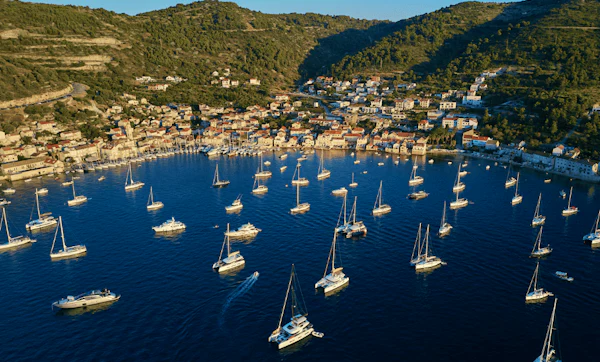
Vessel Density in the Mediterranean
Although the Mediterranean Sea covers less than 1% of the world’s ocean surface, it is one of the busiest maritime regions on Earth. Every day, thousands of vessels navigate its waters, including large commercial ships, cruise vessels, ferries, yachts, and recreational boats.
At any given moment, approximately 2,000 to 3,000 large commercial vessels are cruising through the Mediterranean. Millions of passengers pass through European ports every year, with countries such as Greece, Italy, Spain, and Croatia recording some of the highest numbers of maritime arrivals.
In Europe, around 6 million boats are used for recreation and 4,500 ports are available, providing a total of 1.75 million berths.
During the summer season, the pressure on marine ecosystems increases significantly as hundreds of thousands of recreational boats, yachts, and coastal vessels join the already intensive maritime traffic. This makes the Mediterranean one of the areas most exposed to continuous underwater noise pollution.
According to the European Environment Agency, almost 90% of Europe’s seas are exposed to ongoing shipping noise, with the Mediterranean among the most affected regions.

Underwater Noise
Unlike plastic waste or chemical pollution, underwater noise is invisible, yet its impact on marine ecosystems can be equally significant. Water is an extremely efficient conductor of sound, allowing sound waves to travel approximately four times faster underwater than through air.
Large commercial vessels generate continuous low-frequency noise, reaching between 150 and 190 decibels at the source. To put this into perspective, a jet engine during take-off produces around 140 decibels on land.
For humans, these numbers may be difficult to imagine, but for marine species that depend on sound for survival, the consequences can be severe. Many ocean animals rely on acoustic signals to navigate, communicate, find food, and avoid predators.
The main source of underwater noise is not only the ship’s engine but also the propeller. As propeller blades rotate, they create tiny air bubbles that rapidly form and collapse in a process known as cavitation. This process generates a significant amount of underwater noise that can travel across large distances.

Silent Crisis
For many marine animals, sound is essential for survival. Dolphins, whales, and numerous fish species rely on acoustic communication to locate food, navigate their surroundings, reproduce, and maintain social connections.
Increasing levels of underwater noise disrupt the oceans’s natural soundscape. For species that use echolocation, such as dolphins and some whale species, constant shipping noise can make it more difficult to detect prey, communicate with their groups, and interpret their surroundings.
This effect can be compared to trying to have a conversation in the middle of a busy city street, the louder the background noise becomes, the harder it is to understand and respond to important signals.
Long-term exposure to underwater noise can also cause chronic stress in marine organisms. Research has shown increased stress hormone levels in certain species, while others experience changes in feeding behaviour, reproductive patterns, and movement.
In some cases, marine animals are forced to abandon traditional feeding and breeding areas due to constant disturbance, contributing to habitat fragmentation and further pressure on already vulnerable ecosystems.

What Electrification Actually Brings?
When people think of electric boats, they usually think of cutting carbon emissions (CO2) and preventing diesel and oil spills but swapping combustion engines for electric propulsion offers massive, overlooked advantages:
| Benefit | How it Works / Impact |
|---|---|
Drastic Noise Reduction | Electric motors run almost completely silent. Without heavy engine vibrations and optimised propeller designs, the underwater acoustic footprint drops significantly, instantly restoring the marine habitat. |
Zero Fluid Pollution | No engine oil, no fuel filters, and zero risk of fuel spills during refuelling or bilge pumping. This keeps fragile coastal zones and swimming areas perfectly clean. |
Instant Torque & Control | Electric motors deliver maximum power instantly. This gives captains and recreational boaters much better maneuverability in tight spots like crowded Mediterranean marinas, reducing accidental collisions with docks or shallow marine beds. |
Elimination of Wake & Erosion | Many modern electric ferries and boats utilise advanced hull shapes (like hydrofoils). Because they glide above or smoothly through the water, they create minimal wake, drastically reducing shoreline erosion in narrow channels and shallow bays. |
Low Maintenance & High Comfort | With far fewer moving parts, electric boats don't require oil changes or complex winterizations, and replacing components in the event of a breakdown is much simpler and also cleaner than with traditional diesel engines. For passengers, the absence of diesel fumes and loud engine rumbles makes the journey incredibly peaceful. |
The Human Side of Quieter Boating
Boat engine noise is often discussed for its impact on marine life, but it also affects people. Continuous noise from engines and generators can interrupt the natural sounds of the sea that promote relaxation, leading to mental fatigue, disrupted sleep and a less enjoyable boating or holiday experience. This is particularly important for guests staying on board, waterfront communities, marina staff and children, who are often more sensitive to environmental noise.
Quieter boating benefits both people and nature. Technologies such as electric propulsion significantly reduce engine noise, creating a more peaceful environment that improves sleep, reduces stress, makes conversations easier and enhances the overall experience on the water. Combined with good practices such as proper engine maintenance, avoiding unnecessary idling and limiting generator use, quieter boating supports healthier oceans while delivering the tranquil escape that visitors seek.
Conclusion
Every decision made at sea has an impact. From reducing emissions to choosing quieter technologies, sustainable boating is about more than protecting the ocean today. It is about ensuring that future generations can continue to experience the beauty and biodiversity of our seas.